Posts

NEED AND ADVANTAGES OF IPR

Intellectual property rights play an important role in a nation's commerce in the modern world. In this digital age, there is a greater chance of new ideas being taken without the author's permission. The need for strict intellectual property legislation contributes to the overall economy of the respective state. IPR is one of the main sources of security for intangible properties which are still open to the public and which can be quickly replicated by anyone. IP crimes have become the part and parcel of the digitised era leading to failure of business. Intellectual property rights are important for encouraging creativity. Without intellectual property rights, companies and people would not enjoy the full value of their innovations and would devote little time to research and development. ADVANTAGES OF IPR- (I) Innovative and creative ideas to maximize benefits-                                   ...

HOW LONG IS THE TERM OF PATENT PROTECTION?

The current Indian Patent Law is governed by provisions of Patens Act, 1970 as amended by Patents (Amendment) Act, 2005 and Patent Acts Rules, 2006. In Kolkata, the head patent office is situated with its branch offices situated at Chennai, Mumbai and Delhi. It is administered by Controller General of Patents, Design, Trademarks and Geographical Indications. The jurisdiction for filing the patent application depends upon: i. Indian applicant(s): determined according to place of business of the applicant or where the invention originated, place of residence. ii. Other countries applicant(s): determined by the address for service in India. Any application is usually published after expiry of 18 months period from date of priority of application or date of filing of the application whichever is earlier. The applicant can request publication of his application prior to the normal period under a request through a prescribed form and fee. This rule of publication however does not apply if: i...

FORECLOSURE

WHAT IS FORECLOSURE? Foreclosure is the legal method by which a lender seeks to recover the amount owed on a defaulted loan by gaining possession of and selling the mortgaged properties. Typically, default is caused when a borrower misses a certain number of monthly payments, but it may also happen when the borrower fails to satisfy other conditions in the mortgage contract. In India, the Transfer of Property Act, 1882 governs the law on mortgage. A mortgagee (person who advances or lends the money) is entitled to recover his outstanding money under the right of foreclosure. This right is available under Section 67 of the Transfer of Property Act, 1882. The act regards six types of mortgages, namely- 1. simple mortgage 2. mortgage by conditional sale 3. usufructuary mortgage 4. English mortgage 5. mortgage by deposit of title deeds 6. anomalous mortgage. A mortgagee can exercise his right to foreclosure only under the following conditions- • The payment of the debt amount...

Status Quo Cryptocurrency In India

Image
Cryptographic currencies appeared due to technological progress and the evolution of money as a completely liquid medium of exchange. Indeed, originally money fulfilled the function of the exchange of goods. It was then assigned to gold as the universal equivalent. The next stage was the transition to paper money and now we have the emergence of electronic money (e-money). The Indian central bank in 2018 effectively banned crypto transactions after a string of frauds. RBI asked all the regulative authorities to stop their dealing in any kind of private cryptocurrency effective immediately. The Supreme court in March 2020 quashed the decision by RBI on grounds of disproportionality. The bench, headed by Justice Rohinton F Nariman, noted that RBI failed to show any concrete damages connecting the frauds and the crypto dealings. Basically, cryptocurrency is a form of digital asset based on a network that is spread across large number of computers. This makes it a decentralized...

ANALYSIS OF NATIONAL EMERGENCY

Image
46 Years ago, a state of Emergency was declared in India by the then President Fakruddin Ali Ahmad as per the behest of Smt. Indira Gandhi, the then Premier. By virtue of Article 352 (1), the emergency was communicated. The grounds for same was “a grave emergency exists whereby the security of India was threatened by internal disturbances”. In addition, the government cited the 1971 war with Pakistan and the drought of 1972 as reasons for imposing the emergency on 26th June, 1975. It is important to be aware of the series of events that lead to the 21-month long emergency. It all started with the peculiar judgement of State of Uttar Pradesh v/s Raj Narain wherein the Allahabad High Court convicted Indira Gandhi of having indulged in electoral malpractice, thereby declaring her election to be in contravention, and hence null and void. Making Smt. Gandhi approach the Supreme Court and then finally the President who then declared the emergency. From the above it is very clear that, alth...

FUTURE OF DIGITAL FORENSIC

Image
Introduction-: Digital forensics deals with the recovery and investigation of fabric found in digital devices. It includes investigation of each device capable of storing digital data. The discipline emerged completely within the 21st century with the emergence of national policies. it's applications in criminal or civil courts to support or refute a hypothesis. Digital forensics is additionally partitioned into a couple of branches - computer, mobile device, network, forensic data analysis and database forensics. Forensic science is relatively new field and cyber forensics is even newer. There are different fields of cyber forensics and each field in itself is extremely difficult to practice. Nevertheless, significance of cyber forensics can't be undermined especially in contemporary times of space laws, AI and Internet of Things (IoT). Future Paradigms-: Many of the digital forensics’ tools tailored to discovering evidence are expected to reside on the suspect’s device, but ...

DISASTER MANAGEMENT IN INDIA

Image
Natural disasters or human-made disasters can happen anytime. They interrupt the normal functioning of the environment and society. To bring it under immediate control, there is a need for emergency intervention to bring things under management. The effects of the disasters must be put to ease to control the situation and the properties from getting destroyed. Disaster management is a multi-faceted program which involves saving of lives of people, animals and properties during the occurrence of a natural disaster or a disaster caused due to manmade activities. It deals with different kinds of disasters like drought, earthquakes, floods, hurricanes and landslides. In India, the Disaster Management Act, 2005 is the legislation which provides a framework for disaster management and mitigation. The Act calls for the establishment of National Disaster Manageme...

ABETMENT OF SUICIDE

Image
Introduction: The term 'abetment' refers to the instigation, conspiracy, or aiding in the commission of a crime in the context of suicide, it usually refers to the instigation of the person who has committed suicide. Abetment of suicide is defined under Section 107 of IPC, where as abetment is defined under Section 109 IPC and it is punishable under section 309 IPC. Legally, whether a death is a suicide or not is a factual determination, which means evidence must be evaluated to determine whether or not the death was a suicide. Suicide abettment is a cognizable, non-bailable, and non-compoundable. The crime of abetment of suicide has two main elements- 1. a suicide death, 2. the accused's intent to aid in such suicide. 3. involvement of the accused should be direct In case of M. Mohan v. The State,[1] it was held that there should be a direct link between the accused's actions and the act of committing suicide. It cannot be said that the accused instigated or intenti...

SEDITION LAW

Image
Every citizen has been given freedom to speak and express their views under Article 19(1)(a) of the Indian Constitution. However, this freedom is not absolute and some reasonable restrictions have been imposed on freedom of speech and expression under Article 19(2). But when a person does an act by his words, signs or representation which is held to be contemptuous towards the Government of India, then such act is punishable under section 124-A of Indian Penal Code, 1860. Sedition is an offence that criminalizes speech that is regarded to be disloyal to or threatening to the state. The provision of Section 124A is very wide and it covers the act of defamation of the Government excluding any criticism in good faith of any particular measures or acts of administration.  WHAT IS SEDITION LAW? Section 124A of the Indian Penal Code (IPC), which deals with sedition, was drafted by Thomas Babington Macaulay and included in the IPC in 1870.  WHAT DOES SECTION 124 A STATES? SECTION ...

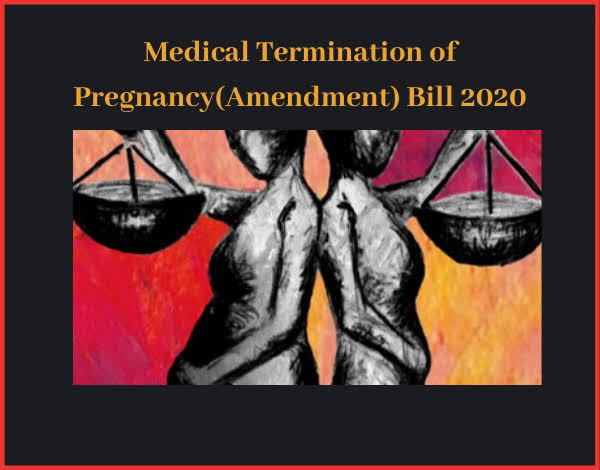
The Medical Termination of Pregnancy (Amendment) Bill, 2020

Image
Introduction Abortion is looked at with a different lens in every country, while some question the morality of the act, some see it through a gender-based lens. In India it is mostly the latter scenario. The most legal debate on abortion is pro-life vs pro-choice but India is a country that comes into the category of liberals so abortion is legalized but inly till a specific time and the parent\s are given the autonomy to decide whether to abort or not based on the given time limit. The Medical Termination of Pregnancy (Amendment) Bill, 2020 The act was amended recently on 17th March 2020. This amendment set up a Medical termination boards having gynaecologists, paediatricians, radiologists, sonologist, and others in each state and union territory to decide on abortion-related issues. Now The Act, because of a shortage of doctors require only one medical practitioner's opinion for abortion before 20 weeks of conception and two medical practitioner's opinion for abortion betwee...

GUARDIANSHIP

Image
Guardianship A child, an insane or a disable person requires a constant care of someone mature in regards to their personal well-being and their property . This is what the concept of guardianship provides. Guardian is someone who is responsible for care and protection of someone who is not competent to take care of his own self or his property. Guardianship and Wards Act, 1890 and Hindu Minority and Guardianship Act, 1956 governs guardianship in India. Muslims and Christians are governed by their personal laws. It is in fact a legal and practical relation between parents or guardian and child. The guardian takes all the important decisions which are essential for well-being of the protected person . Following are the broad types of guardian under Hindu law. Natural guardian: Generally, father, mother and husband can be natural guardian. It actually depends on legitimacy of child. In case of legitimate child, father is the natural guardian of a minor child. The guardianship of minor...

Representation of people act

Image
INTRODUCTION Before the first general elections, the Indian parliament enacted the Representation of People Act, 1951which provided the actuality of how elections should be conducted in India. The Act deals with details like eligibility and disqualification of members of both the Houses of Parliament and State Legislative Assemblies. The registration of political parties, administrative machinery of performing elections, poll, by-elections etc. are explained in detail along with the offences related to the same. KEY PROVISIONS  Qualifications- Minimum age for becoming an MLA/MP of Lok Sabha is 25 years, and for the levels of Panchayat and municipality is 21 years. Such person should be an elector in the constituency.  Right to Vote- • Section 62 ensures that every person enrolled in electoral roll of constituency is entitled to vote only for the one-time. • If a person is under a sentence of imprisonment, he cannot vote. If he is in preventive custody, he is eligible to cour...

CONCEPT OF MEDIA LAW

Image
Media law is law that regulates media production and use. Media law can encompass many different types of media including broadcast television, internet and print media. The practice of media law may involve all of the types of legal issues that might arise during the production or consumption of various types of media. In India, the Press is free but subject to certain reasonable restrictions imposed by the Constitution of India, 1950, as amended.. Before the impact of globalization was felt, the mass media was wholly controlled by the government, which let the media project only what the government wanted the public to see and in a way in which it wanted the public to see it. However, with the onset of globalization and privatization, the situation has undergone a humongous change. Media laws in India have a long history and are deeply rooted in the country’s colonial experience under British rule. There have been many changes from colonial era till the time of independence. Howev...

ANTI DEFECTION LAW: LINK WITH WEST BENGAL ELECTION

Image
                             ●ANTI DEFECTION LAW The ANTI DEFECTION LAW is the TENTH SCHEDULE OF INDIAN CONSTITUTION which enacted by the 52nd constitutional amendment act in 1985. The Anti Defection law came into effect on March 1, 1985. The anti defection law formulated to bring stability in the Indian political system. The Indian Political System have long history of Political defection. “AYA RAM GAYA RAM” famous slogan coined in 1967 when Haryana MLA Shifted his loyalty in three parties in single day. According to Anti defection law a member of a house belonging to any Political party can be disqualified if he voluntarily give up the membership of such political party or if they vote or abstain from voting in contrary to direction issued by their party's whip. But their is an exception in ...

ENCOUNTER KILLING

Image
Encounter killings in India are done in self defense as a result of attacks from accused or convicts by police or armed forces. However, in recent years these extra judicial killings have experienced a significant rise. There have been many reports on false encounter killing initiated by various police officials as well. The sections pertaining to encounter killings are Section 96 and 100 of Indian Penal Code and Section 46 of Criminal Procedure Code. It is evident through these sections that the infliction of force by the police or armed forces has to be justified and must be in self-defense. If any encounter killing has been done in violation of these principles then it will be treated as culpable homicide under section 299 of Indian Penal Code. With respect to fake encounters, a total of around 1800 cases were record between 2000 and 2017 as per data retrieved from National Human Rights Commission. In 1997, National Human Rights Commission laid down certain guidelines to coun...

ROLE OF AN AGENT

Image
An individual hired to do some act for another or to represent another in interactions with third parties is known as an agent.  The ‘principal' is the person by which such an act is performed or who is so portrayed. The 1872 Indian Contract Act makes no difference between various types of agents.  On the one hand, an agent may be designated by the principal; on the other hand, it may be employed by any entity approved by statute to do so.  The Agent has certain responsibilities under Indian law. An agent is obligated to perform his principal's business in accordance with the principal's instructions or, in the absence of such instructions, according to the prevailing custom.  An agent is obligated to perform the agency's business with as much expertise as is reasonably possible.  An agent is obligated to provide his principal with correct accounting on request.  In tough situations, it is an agent's responsibility to communicate with his princi...

PROPERTY DIVISION IN MUSLIM LAW

Image
INTRODUCTION Succession is both a legal and a practical requirement. Every individual will be required to renounce the world once, after which all of their legal rights and responsibilities will be dissolved and transferred to someone else. In India, succession is governed by religiously based personal laws. As a result, the rule of succession is influenced by one's faith on religion. “THE MUSLIM PERSONAL LAW (SHARIAT) APPLICATION ACT, 1937”, deals with intestate succession, the special property of women, inheritance, and the transfer of property under a gift or any other provision that is a subject of personal law among Muslims. DIVISION In Muslim law, the two forms of succession are also recognised. In the event that a man leaves a valid will, testamentary succession occurs, and the property is divided according to the will. When a person dies without leaving a will, intestate succession takes place. Since the joint family system is not recognised, the heirs are limited to t...

CONTRACT WITH MINOR

Image
One essential of a valid contract is the competence of the parties to form a contract. Section 11 of the Indian Contract Act, 1872, states that the capacity to contract for an individual is: 1. Attaining the age of majority (As per the Indian Majority Act, 1875, the age of majority in India is specified as 18 years) 2. Being of sound mind and 3. Not disqualified from entering into a contract by any law Who would be a Minor? Any individual, domiciled in India, who has not attained the age of 18 years, is referred to as a minor. What is the contractual capacity of a minor? A contract with minors stand null and void. Any contract with a minor, that is any individual less than 18 years of age cannot contract, is void ab-initio (from the beginning). Mohiri Bibi v. Dharmodas Ghose The case dates back to the year 1903, in which, for the first time, the Privy Council ruled that the marriage of a minor was void-ab-initio and that the contract was void from the start. 1. The appell...

UNIFORMITY IN LEGAL AGE OF DRINKING IN DELHI:

Image
Alcohol intake, legal drinking age in India, and uniformity in legal drinking age in India have all been contentious and contentious issues in India. According to a recent survey, per capita alcohol consumption in India has more than doubled between 2016 and 2020. Moreover, despite alcohol bans in some states across the country, over 88 percent of Indians under the age of 25 purchase or drink alcoholic beverages. According to India's current alcohol laws, each state has the authority to enact its own legislation. This has caused a great deal of uncertainty in the minds of Indian people, as well as widespread diversification. The Delhi government declared that the national capital's legal drinking age has been reduced from 25 to 21. In addition, the government has stated that no new liquor stores will be opened in the area. “There will be no government liquor stores in Delhi,” deputy chief minister Manish Sisodia said at a press conference about the cabinet-approved amendments t...

FRAUDULENT TRANSFER UNDER SECTION-53 A TPA

Image
Introduction : - Each transfer of immobile property created with intent to defeat or delay humans of the transferrer shall be revocable at the choice of any creditor thus defeated or delayed, And every transfer of immoveable property created inconsiderately, with shall diddle a resulting transferee, is revocable at the choice of such transferee. It deals with 2 forms--- As so much the primary rule cares, once the thought for transfer and honesty on the a part of transferee square measure gift, the intention of the transferrer to defeat or delay his human is immaterial. Thus,S.53 incorporates a restricted scope restricted to immobile property and to not movable property. What is more the good thing about this section isn’t restricted to existing creditors alone, however it extends to resulting creditors conjointly. This section doesn’t create the interpretation void-ab-initio however solely revocable which to solely at the choice of anyone defeated delayed or defrauded...